You're staying in a country where a news site you rely on loads a blank error page. A colleague mentions a VPN. You install one, reload, and the site comes through. Two days later, a different blocked site still won't load even with the VPN running.
Both results make sense. Internet censorship is not one thing — it operates at different layers, and a VPN addresses some of them and not others. Understanding where your particular block lives determines whether a VPN is the right tool.
How Internet Censorship Works
Most content blocking operates at one of three layers.
DNS blocking is the simplest method. When you type a website address, your device sends a query to a DNS resolver — typically run by your ISP — asking for the IP address behind that name. A network with control over your resolver can return nothing, or return a wrong address, for blocked domains. The site still exists on the internet; your device is just being misdirected.
IP address blocking goes a step further. Even if DNS works correctly, your ISP can drop all connections destined for specific IP addresses. Blocklists of banned IPs can be distributed to routers across an entire national network.
Deep packet inspection (DPI) is the most sophisticated layer. Rather than looking at destinations, DPI-capable equipment examines the content of network traffic as it flows through. This enables filtering based on what the packets contain, not just where they're headed — and it also enables something else: detecting the fingerprints of VPN protocols themselves.
What a VPN Changes
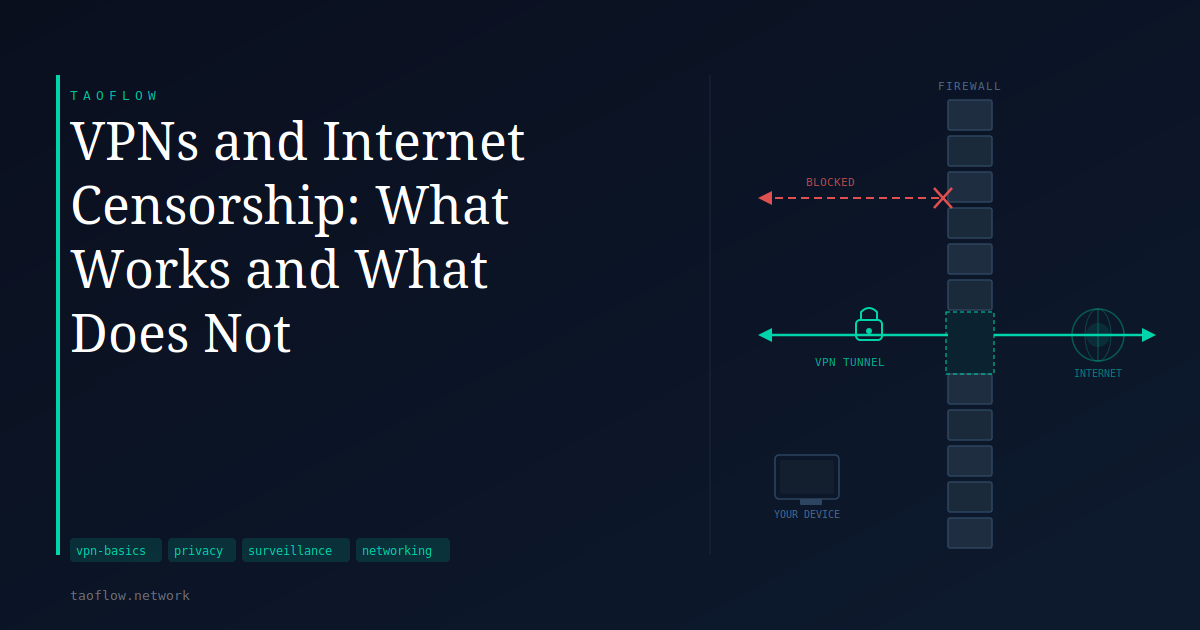
A VPN routes your traffic through an encrypted tunnel to a server in a different location. From that point, traffic to the open internet originates from the VPN server's IP address, not yours.
Against DNS blocking, a VPN is straightforwardly effective: your DNS queries travel through the encrypted tunnel, bypassing your ISP's resolver entirely. Against IP blocking, it works equally well: the blocked site's IP is only known to the VPN server, which the filtering network sees as just another connection. The encrypted tunnel also prevents your ISP from reading the content of your traffic.
For censorship that relies on DNS or IP blocklists — which describes most everyday filtering systems — a standard VPN works reliably.
Where VPNs Run Into Trouble
Some networks don't just block destinations; they block VPN protocols themselves. WireGuard has a recognizable handshake pattern. OpenVPN traffic has a distinctive signature. A DPI system configured to detect and drop those connection patterns can stop a VPN tunnel before it establishes, regardless of where the server is located.
Legal constraints add a different kind of limitation. Some countries restrict or prohibit VPN use outright, requiring users to go through state-sanctioned alternatives. In those environments, the question is less about technical effectiveness and more about the legal risk of using a non-approved service.
There is also a limit at the content layer. If censored material has been removed at the source — taken down by a hosting provider under legal pressure rather than blocked at the network edge — a VPN cannot retrieve it. The content simply isn't there.
Protocol Obfuscation
When VPN protocols are being actively blocked, some clients offer obfuscation: wrapping VPN traffic inside another protocol, such as HTTPS, so that DPI systems see what looks like ordinary web traffic rather than a VPN connection.
This can restore access in environments where standard VPN connections are being dropped. It isn't a permanent fix, though. Filtering systems can detect obfuscated traffic through statistical patterns — packet timing, size distributions — rather than content alone. The technical landscape of censorship circumvention involves ongoing adaptation on both sides, and what works in a given country today may not work in a year.
What This Means for You
If you're traveling somewhere with internet restrictions, or need to access content blocked in your region, here is what to consider:
- A standard VPN is likely sufficient for DNS and IP-based blocking, which covers most everyday filtering.
- Research the specific situation before you travel. VPN provider websites and app stores may themselves be blocked, so download everything you need before you arrive.
- If standard VPN connections are being dropped, look for a client that supports traffic obfuscation.
- Be clear-eyed about legal risk. Using a VPN does not place you outside local law, and in some jurisdictions circumventing internet restrictions carries real consequences.
- A VPN hides the content of your traffic from the local network, but a sophisticated observer can often still detect that you are using a VPN.
A VPN is a practical tool for bypassing many forms of internet censorship, particularly DNS and IP-based filtering. It is less reliable against systems that detect and block VPN protocols themselves, and it offers nothing against content removed at the source or legal prohibitions on its use. Knowing which layer the blocking operates at — and the legal context you're in — is what determines whether a VPN is the right approach.