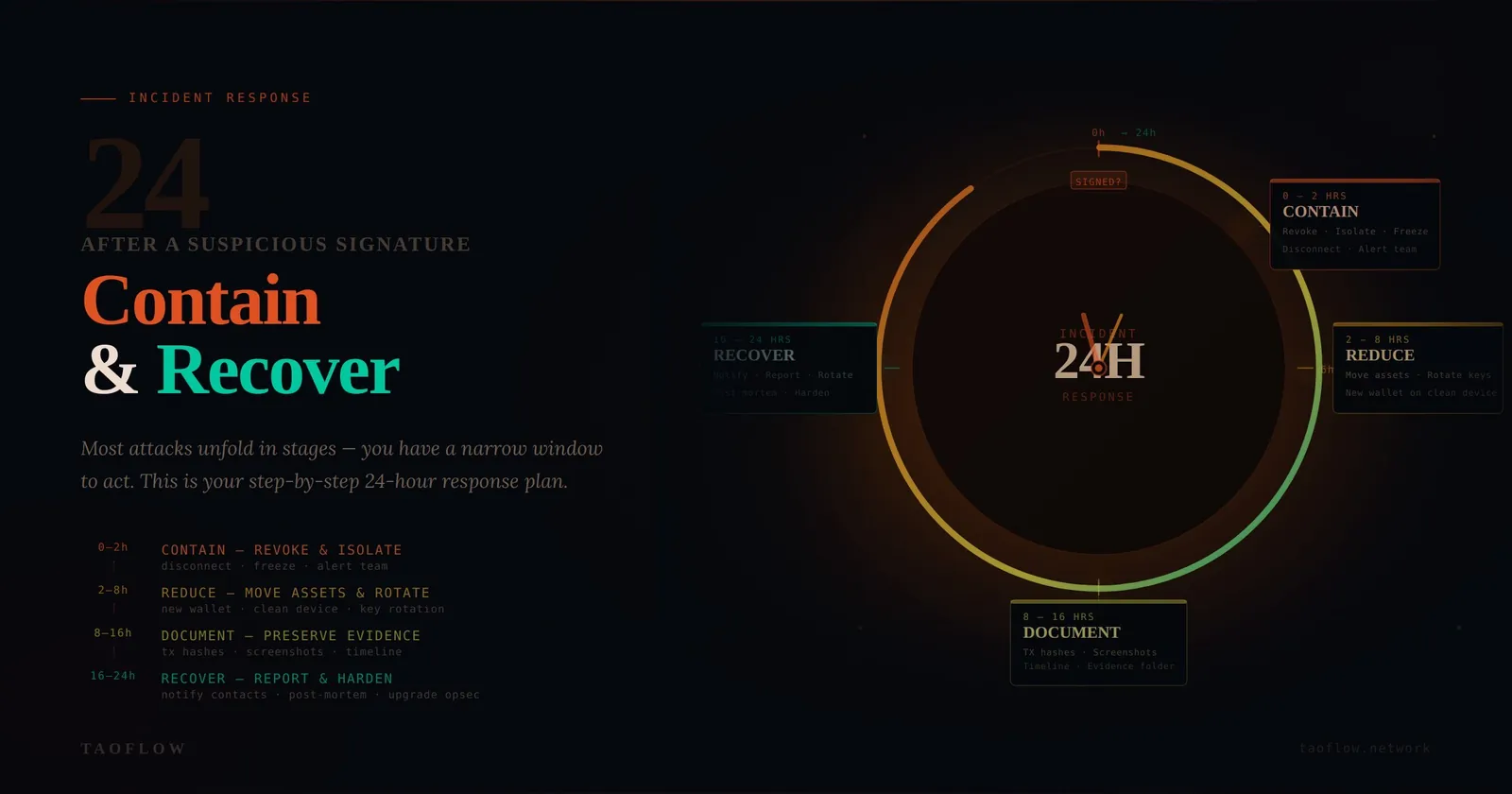
Most crypto losses are not instant drain events. Many attacks unfold in stages: permission abuse, session takeover, social engineering follow-ups, and delayed wallet sweeps. That gives you a narrow but real window to contain damage—if you act in order.
This guide is a practical 24-hour incident response plan for individual users and small teams. Save it now, because response quality drops fast under stress.
What counts as a “suspicious signature” incident?
Treat it as an incident if any of these happened:
- You signed a transaction or message on a site you cannot fully verify.
- Your wallet asked for unusually broad approvals.
- You connected a wallet after clicking an unknown link from social media, ads, or DM.
- You approved a transaction that didn’t match what you intended.
- You see unknown approvals, sessions, API keys, or login alerts.
If you are unsure, assume compromise until proven otherwise.
Threat model in one minute
After a malicious or risky signature, attackers usually try one or more of these paths:
- Token approval abuse: use unlimited allowances later.
- Session hijack: steal authenticated browser sessions and trigger actions off-device.
- Account pivoting: compromise email/X/Discord/Telegram to reach your contacts.
- Timed drain: wait until balances increase, then execute.
Your goals in the first 24 hours are simple:
- Contain access
- Protect remaining assets
- Preserve evidence
- Rebuild from a clean state
The 24-hour containment checklist
0–15 minutes: Stop the bleeding
- Disconnect immediately: close the suspicious tab and wallet popups.
- Isolate device networking (if behavior is abnormal): airplane mode or disconnect Wi-Fi.
- Move high-value assets from exposed wallet(s) to a pre-prepared clean wallet using a separate trusted device if possible.
- Pause automation: bots, scripts, API traders, browser extensions with signing permissions.
Do not keep “testing” the suspicious site. Curiosity causes second compromise.
15–60 minutes: Revoke and rotate
- Revoke token approvals for affected addresses (start with stablecoins and high-value tokens).
- Rotate critical credentials in this order:
- Primary email password
- Email 2FA reset/rebind
- Exchange accounts
- Social and community accounts (X, Discord, Telegram)
- Invalidate active sessions everywhere (email, exchanges, social platforms, password manager if needed).
- Check forwarding rules in email for stealth persistence.
Tip: if you use a hardware wallet, verify that no blind-sign settings remain enabled unnecessarily.
1–4 hours: Verify blast radius
- Build a quick incident log:
- time of suspicious action
- wallet addresses involved
- tx hashes / signed messages
- dApp URL and referral source
- Review:
- recent on-chain approvals and transfers
- new device logins on key accounts
- bot/app integrations you don’t recognize
- Alert close collaborators if shared multisig or operations wallets might be affected.
At this stage, avoid public posting of full details that could help copycat attackers target you again.
4–12 hours: Rebuild trusted environment
- Use a known-clean browser profile (or clean OS account) dedicated to crypto actions.
- Reinstall only essential wallet extensions; remove “nice-to-have” plugins.
- Reconnect accounts with least privilege:
- use smaller spending wallets for daily DeFi activity
- keep treasury/cold funds segregated
- Re-enable automations one by one with review checkpoints.
One lightweight habit that helps: route wallet operations through a separate private access path so your normal browsing identity is less linkable to your signing activity.
12–24 hours: Recovery hardening
- Set wallet and account monitoring alerts for:
- approval changes
- large transfers
- login from new device/location
- Schedule a weekly approval review (10 minutes).
- Document what failed in your process:
- verification gap
- rushed decision point
- missing checklist step
- Create a one-page “panic runbook” for future incidents.
Incidents are expensive tuition. Capture lessons while details are fresh.
Minimal personal incident kit (prepare before you need it)
Keep this ready:
- 1 clean emergency wallet (never used for random dApps)
- 1 backup device or hardened browser profile
- 1 password manager with emergency sheet
- list of official revoke/check URLs you trust
- contact template for team/community warning
Preparation turns chaos into procedure.
Common mistakes that make losses worse
- Delaying response because “funds are still there.”
- Rotating social passwords but forgetting email/session invalidation.
- Continuing to use the same browser profile after compromise.
- Posting full wallet details publicly before containment.
- Treating revocation as complete recovery.
Revocation is one control, not the finish line.
Final takeaway
A suspicious signature is not just a wallet problem—it is an identity and operations problem. If you follow a structured 24-hour response, you can often prevent a small mistake from becoming a total loss.
Print this checklist, adapt it to your stack, and run a quarterly drill. Speed and order matter more than perfect tools.