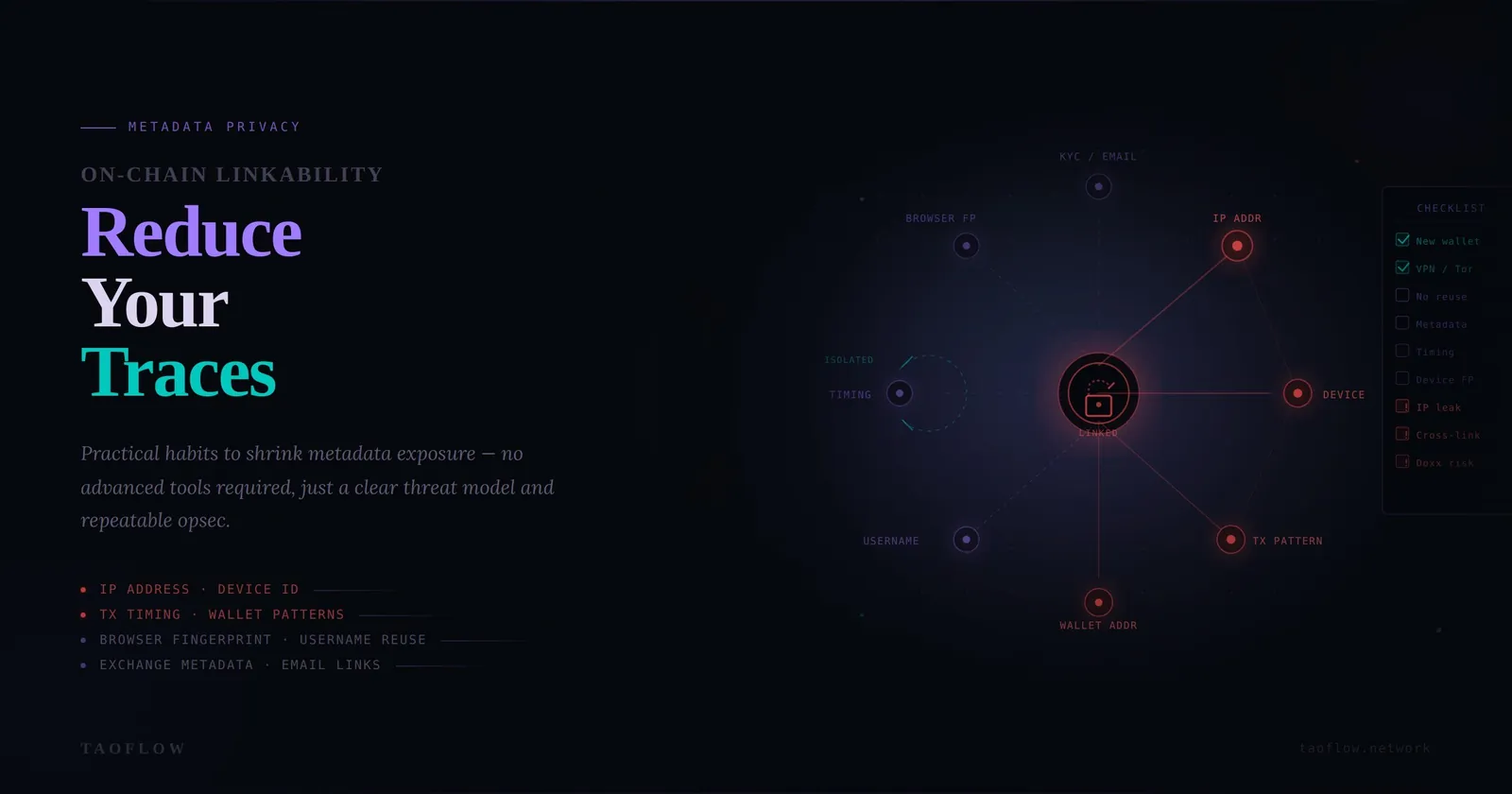
Most crypto users focus on private keys and seed phrases. That makes sense—if those are compromised, funds are at risk immediately. But many losses, doxxing events, and targeted attacks start earlier, through metadata.
Metadata is the context around your activity: when you transact, which device you use, where you connect from, which addresses interact repeatedly, what usernames are reused, and what patterns tie everything together. Attackers do not need your seed phrase if they can profile you first.
This guide is a practical checklist to reduce linkability. You do not need advanced cryptography knowledge. You need a clear threat model and repeatable habits.
1) Start with a simple metadata threat model
Before changing tools, identify what you are defending and from whom.
Ask three questions:
- Who might analyze your metadata?
- Chain analytics firms
- Scammers and phishers
- Data brokers
- Targeted attackers watching high-value wallets
- What do you want to hide?
- Total holdings
- Wallet relationships
- Location/timezone patterns
- Identity links (email, social handle, ENS, exchange account)
- What level of effort is realistic for you daily?
- Strong privacy setups fail when they are too hard to maintain.
Write your answers in 5–10 lines. If your model is vague, your setup will be inconsistent.
2) Separate identities by purpose, not by coin
Many users create multiple wallets but still leak linkage through behavior.
Use a purpose-based split:
- Long-term storage identity
- Active trading identity
- Experimental/on-chain app identity
- Public-facing identity (if you share addresses online)
Rules that matter:
- Do not fund every wallet from the same source account in the same pattern.
- Do not sign into the same dApp sessions with all identities.
- Do not reuse the same naming convention (e.g., “main”, “main2”, “main3”) in screenshots, notes, or exports.
The goal is compartmentalization. One identity leak should not reveal your full map.
3) Reduce timing fingerprints
Your activity timing can become a signature.
Common leak patterns:
- Always transacting at the same local time window
- Performing a repeated sequence (bridge -> swap -> transfer) within minutes
- Reacting instantly to market moves from the same addresses
Mitigations:
- Add non-critical timing jitter for routine actions.
- Avoid predictable transaction batching schedules tied to your local day.
- For sensitive moves, avoid doing all steps in one continuous session.
Perfect randomness is not required. You only need to be less uniquely predictable.
4) Treat network and device metadata as part of wallet security
Address privacy is weakened if network/device fingerprints stay constant.
Device hygiene checklist:
- Keep wallet operations on a dedicated browser profile.
- Minimize extensions in that profile; every extension adds fingerprint surface.
- Disable unnecessary wallet auto-connect and auto-sign prompts.
- Patch OS/browser promptly.
Network hygiene checklist:
- Avoid mixing sensitive wallet operations with high-noise browsing sessions.
- Avoid logging into personal accounts in the same session used for sensitive wallet tasks.
- Be careful with public Wi-Fi; assume passive collection is possible.
You do not need “perfect invisibility.” You need fewer stable identifiers across sessions.
5) Control off-chain linkage points
Many users secure on-chain behavior but leak identity off-chain.
High-risk linkage points:
- Reused email addresses across exchanges, socials, and governance accounts
- Shared usernames/avatars across pseudonymous and real-identity platforms
- Public support tickets that include wallet addresses and personal details
- Clipboard/history leaks from note apps and password managers used carelessly
Action plan:
- Use distinct contact channels for public crypto activity and personal life.
- Audit public posts for address reuse and transaction screenshots.
- Remove unnecessary historical wallet references from old profiles.
A lot of “on-chain deanonymization” starts with off-chain breadcrumbs.
6) Build a verification workflow before every signature
Metadata privacy and phishing defense overlap. The fastest way to leak identity is to sign malicious payloads during rushed sessions.
Before signing anything:
- Verify domain and exact path, not just page design.
- Verify contract address from an independent source.
- Read wallet prompts fully; reject unclear approvals.
- Prefer smaller, revocable approvals where possible.
This is also where one light tool mention fits: if you use a privacy access layer, use it to keep wallet sessions isolated and context-specific instead of browsing everything in one environment.
7) Prepare a metadata incident response mini-plan
If you suspect linkage or exposure, speed matters.
First 30 minutes:
- Pause non-essential activity from affected identities.
- Snapshot what leaked (address, username, IP/session clues, screenshots, signed messages).
- Rotate sensitive off-chain accounts first (email, exchange, social logins).
- Move critical funds only after you verify destination hygiene and route.
Next 24 hours:
- Re-map identity boundaries.
- Retire high-risk wallet relationships.
- Rebuild daily workflow with fewer shared identifiers.
Do not wait for confirmed theft. Metadata exposure often precedes active attacks.
Daily 10-minute metadata privacy routine
Use this quick checklist once per day:
- [ ] Did I separate today’s actions by identity purpose?
- [ ] Did I avoid account/session mixing?
- [ ] Did I verify every signature target independently?
- [ ] Did I expose new personal clues in public posts or chats?
- [ ] Did I update or patch the environment I used for wallet tasks?
Consistency beats complexity. Most users do not need exotic setups—they need disciplined repetition.
Final takeaway
Crypto privacy is not only about hiding balances. It is about reducing the number of clues that let others connect your wallets, devices, and real-world identity.
If you improve metadata hygiene, you lower phishing success rates, reduce targeted attack risk, and make your overall security model more resilient over time.
Start small, but start today: define your threat model, separate identities by purpose, and apply one checklist every day.