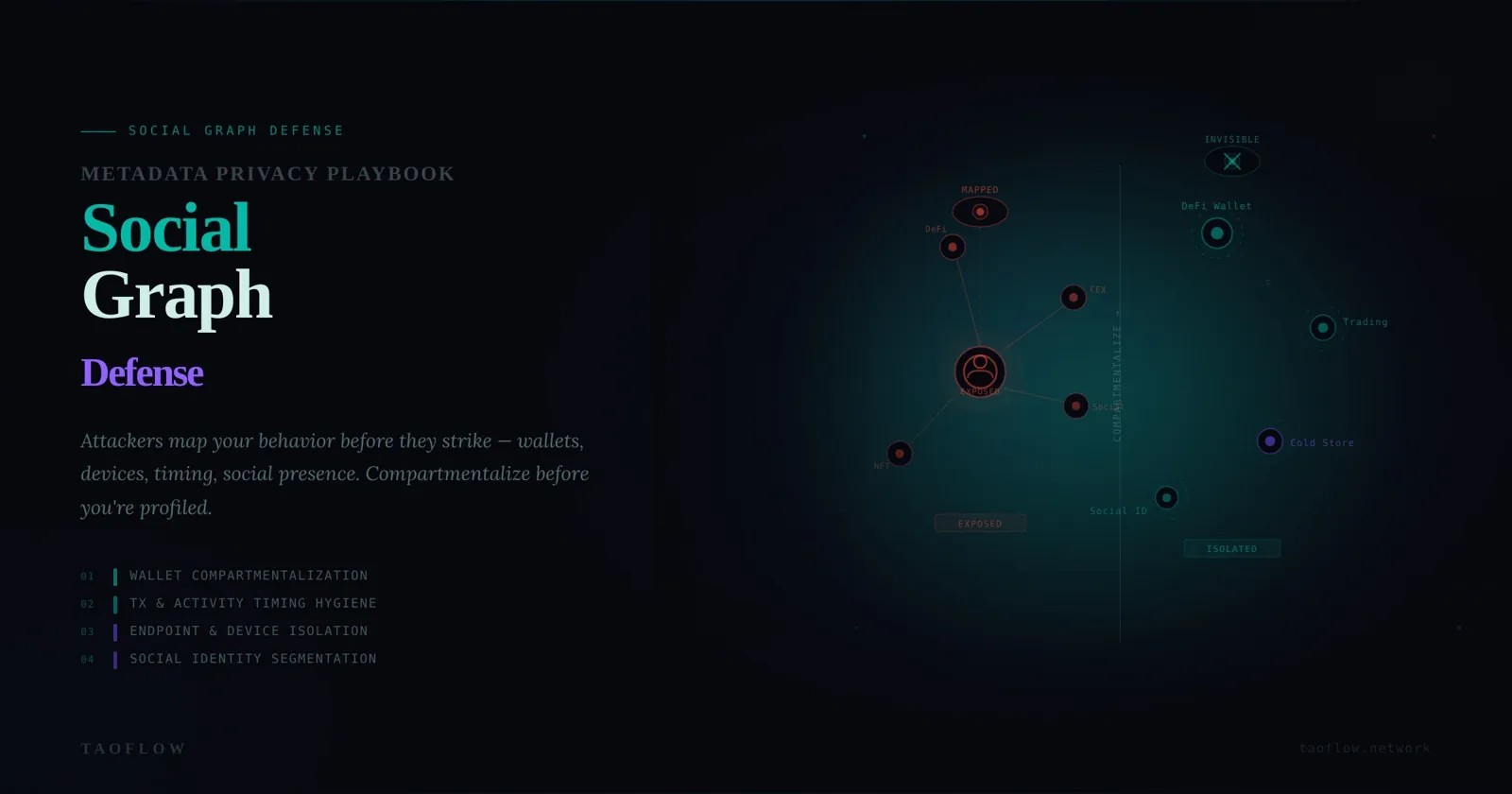
Most crypto users spend time protecting private keys, seed phrases, and signing behavior. That is necessary—but it is not sufficient.
A large share of real-world losses starts with metadata, not direct key theft. Attackers and scammers often win by mapping your behavior first: when you are active, which wallets likely belong to you, where you discuss trades, what devices you use, and which channels can pressure you socially. Once your social graph is clear, targeted phishing, impersonation, and coercion become much easier.
This guide focuses on practical metadata privacy for normal users. You do not need a perfect setup. You need a repeatable system that reduces linkability and slows adversaries down enough for your verification habits to catch attacks.
1) Understand what “metadata exposure” looks like
You can keep your seed phrase offline and still leak enough context to become an easy target. In crypto, common metadata leaks include:
- Wallet linkability: repeated interactions that reveal multiple addresses are controlled by one person.
- Timing patterns: consistent login, bridge, or trading windows that fingerprint your routine.
- Social cross-linking: same handle/avatar/style across Discord, X, forums, governance, and support tickets.
- Device/browser fingerprints: wallet use mixed with normal browsing identity and persistent cookies.
- Transaction narration: public comments, screenshots, or “just sent” messages that correlate with on-chain events.
Treat metadata as an attack surface. The goal is not invisibility; it is to break clean correlation chains.
2) Build a role-based wallet map (and keep it boring)
Most linkability disasters happen because one wallet does everything. Fix that first.
Use separate wallets by role:
- Vault wallet: long-term holdings, minimal movement, near-zero app connections.
- Operations wallet: daily transfers, bridges, swaps, fee management.
- Interaction wallet: dApp testing, mints, unknown contracts, campaign tasks.
Rules that matter:
- Never sign unknown contracts from your vault wallet.
- Do not directly fund interaction wallets from your identity-visible exchange account when avoidable.
- Move funds through your own planned path, not impulsive one-hop transfers that create obvious links.
- Label wallets privately (local password manager/notes), not publicly on social posts.
Compartmentalization does not remove all on-chain inference, but it significantly reduces single-point blast radius.
3) Apply timing hygiene to reduce behavioral fingerprints
Even with separate wallets, predictable timing can expose you.
Common mistakes:
- Always doing transfers right after salary/day-end.
- Posting “done” in chat seconds after a transaction.
- Claiming rewards at exactly the same time each day.
Practical timing hygiene:
- Add random delay windows for non-urgent actions (for example 15–90 minutes).
- Batch low-priority operations into fewer sessions.
- Avoid live-posting transaction progress in public channels.
- If you must confirm publicly, do it after unrelated activity or with minimal detail.
Think like this: if someone watched only timestamps across chat and chain, how easy would it be to bind identities?
4) Isolate browser and endpoint identities
A lot of metadata leakage happens off-chain through browsers and device context.
Minimum viable isolation:
- Use a dedicated browser profile only for wallet activity.
- Disable unnecessary extensions in that profile.
- Keep separate profiles for “known-safe protocols” and “high-risk exploration.”
- Do not log personal email/social accounts into your high-risk wallet profile.
Device hygiene basics:
- Keep OS and browser updated.
- Use endpoint protection and full-disk encryption.
- Remove abandoned wallet extensions.
- Reboot before high-value operations if your machine has been running long mixed sessions.
If you use privacy access tools such as TaoFlow, treat them as one layer in a layered defense—not a replacement for wallet and endpoint isolation.
5) Harden social channels against impersonation mapping
Attackers build target dossiers from public interaction patterns. Reduce the signal.
Social graph controls:
- Separate “public persona” from “operations persona” where feasible.
- Use different profile images/wording styles across high-risk contexts.
- Limit brag posts about holdings, wins, or exact token amounts.
- Never post screenshots showing full addresses, browser tabs, QR codes, or notification previews.
- Audit old pinned posts and bios for unnecessary identifying clues.
Support-channel safety:
- Assume inbound DMs are untrusted unless independently verified.
- Require a two-channel verification rule for urgent requests (e.g., confirm via official ticket + known announcement page).
- Save and reuse your own trusted support links; do not click fresh links from replies.
6) Control transaction narrative leakage
Users accidentally leak context by over-explaining transfers.
Examples to avoid:
- “Moving from CEX to cold in 5 mins.”
- “Bridge failed, retrying from this wallet.”
- “Sent to new address ending 4F9A—can someone confirm?”
Better pattern:
- Ask procedural questions without posting identifiers.
- Share redacted screenshots only when needed.
- Use private troubleshooting notes, then clean up once issue is resolved.
Remember: attackers do not need your seed phrase if they can predict your next risky action and place a convincing fake in your path.
7) Run a weekly metadata audit (20 minutes)
Do this once a week and you will outperform most users:
- Wallet review:
- Any unnecessary approvals still active?
- Any role crossover (vault used for interaction)?
- Browser review:
- Any new extension installed in wallet profile?
- Any personal account accidentally logged in?
- Social review:
- Recent posts revealing timing, balances, travel, devices?
- Old posts that should be deleted or edited?
- Contact review:
- Any “support” contacts not from your verified list?
- Any new groups requesting wallet actions?
- Incident prep:
- Is your emergency checklist up to date?
- Are your trusted contacts and recovery priorities documented?
Put this checklist in a recurring calendar event. Consistency beats intensity.
8) Incident response for metadata compromise
If you suspect your identity-to-wallet mapping is exposed, act quickly:
Immediate (first 30–60 minutes):
- Stop non-essential transactions.
- Assume inbound DMs and “urgent notices” are malicious.
- Revoke high-risk approvals from non-vault wallets.
- Move critical operations to your safer, clean profile/device.
Same day:
- Rotate social/account credentials where risk exists.
- Tighten privacy settings and limit who can DM/tag you.
- Replace compromised interaction wallets for future activity.
- Document suspicious messages, domains, and addresses.
Next 72 hours:
- Monitor for impersonation attempts using your name/avatar.
- Warn trusted collaborators about spoof risk.
- Rebuild your compartment map if crossover occurred.
Do not wait for confirmed theft to respond. Metadata compromise is often the precursor stage.
9) A simple operating standard you can adopt today
If you want a lightweight baseline, start with this:
- 3-wallet model (vault / ops / interaction).
- 2-browser-profile model (trusted / high-risk).
- 2-channel verification for any urgent request.
- 1 weekly metadata audit.
This “3-2-2-1” routine is realistic for individuals and small teams. You can scale from here as your risk increases.
Final takeaway
In crypto, privacy is not only about hiding secrets; it is about reducing the quality of the attacker’s map. Every separation you create—wallet role, browser profile, posting behavior, timing pattern—forces attackers to make more assumptions and gives your security habits more time to work.
You do not need perfect anonymity. You need disciplined, repeatable friction against correlation. Start with one structural change today, then add one more each week. Over time, your metadata surface shrinks, and your resilience grows.