Most crypto losses are not caused by broken cryptography. They happen because users sign the wrong thing at the wrong time.
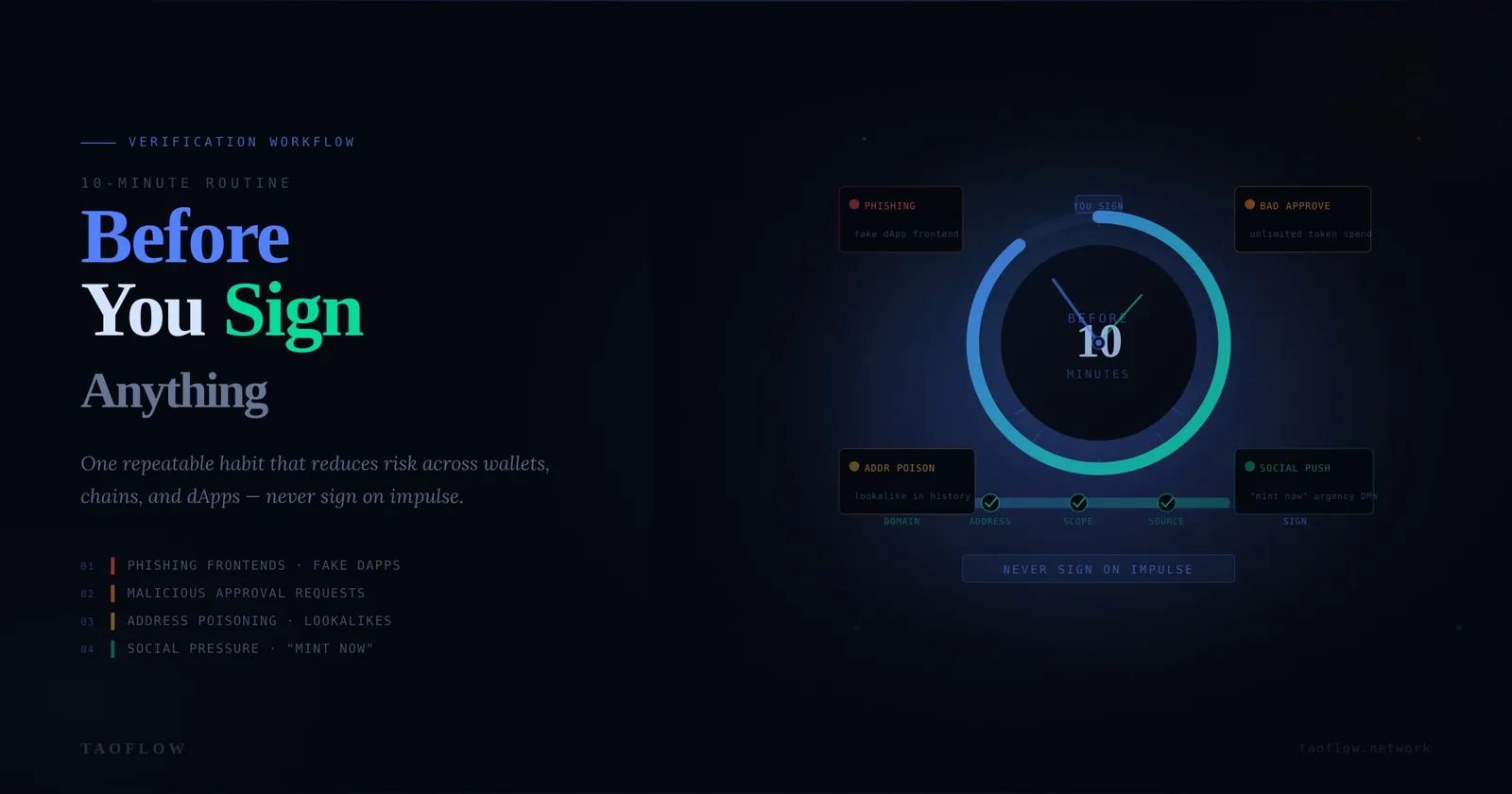
If you want a single habit that reduces risk across wallets, chains, and dApps, build a repeatable verification workflow. The goal is simple: never sign on impulse.
Threat Model: What You Are Defending Against
Before the checklist, be clear about common failure modes:
- Phishing frontends that imitate real dApps.
- Malicious approval requests (unlimited token spend, dangerous permit signatures).
- Address poisoning (copying a lookalike address from recent history).
- Social pressure ("mint now," "airdrop ending," fake support DMs).
- Context switching mistakes (using the wrong wallet/account/network).
Your workflow should catch these five classes of errors quickly.
The 10-Minute Pre-Sign Workflow
Use this in order. If one step fails, stop.
1) Freeze the moment (30 seconds)
- Do not sign immediately after clicking a link.
- Ask: "What am I trying to do, exactly?" (swap, bridge, claim, revoke, stake)
- If the purpose is unclear, cancel.
2) Verify entry point (1 minute)
- Open the protocol from your own bookmark, not from social posts or DMs.
- Confirm domain spelling character by character.
- Check HTTPS lock, but do not treat it as proof of legitimacy.
3) Verify account and network context (1 minute)
- Confirm active wallet address (first 6 + last 6 chars).
- Confirm chain/network is expected.
- Confirm this wallet is meant for this risk level (daily wallet vs vault wallet).
4) Simulate intent in plain language (1 minute)
Before reading gas or signatures, state the expected result:
- "I should send 120 USDC and receive about X ETH."
- "I should approve only this token, with a limited amount."
If the wallet prompt does not match this expectation, reject.
5) Inspect the signature request details (3 minutes)
For transactions:
- "To" address: known protocol contract?
- Value/token amount: correct unit and decimal?
- Function intent: swap/approve/transfer—does it match your action?
For approvals/permits:
- Prefer exact or capped allowance; avoid unlimited unless necessary.
- Check spender address, not just token symbol.
- Check deadline/nonce fields where shown.
For message signatures:
- Avoid blind signing unread payloads.
- Be cautious with messages granting session keys or trading permissions.
6) Independent cross-check (2 minutes)
- Compare contract address with an official source (docs/GitHub/verified announcement).
- If high value: verify via a second channel (team docs + block explorer).
- Check recent community warnings before proceeding.
7) Post-sign hygiene (1.5 minutes)
- Save tx hash and note what you approved.
- For temporary needs, schedule allowance revocation later.
- If anything felt "off," rotate to a cooldown period and review activity.
Red Flags That Mean "Stop Now"
- "Urgent" countdown pressure attached to wallet actions.
- Support staff asking you to sign a "verification" message in DM.
- Approval prompt for a token unrelated to your intended action.
- Unexpected network switch requests.
- A wallet popup that hides key fields or shows unreadable data.
Weekly 15-Minute Audit
Once a week:
- Review active token approvals on wallets you actually use.
- Revoke unused high-risk allowances.
- Move long-term assets out of hot wallets.
- Update your bookmark list and remove stale links.
- Note one near-miss and which workflow step would have caught it faster.
Minimal Setup That Helps This Workflow
- A dedicated browser profile for crypto activity only.
- Separate wallets by role: daily use, experimental, long-term storage.
- A personal checklist in notes so you do not rely on memory under pressure.
Tools that reduce risky context switching (including TaoFlow as one option) can help, but your core defense is the habit: verify first, sign second.
Final Rule
Speed is not alpha if it increases signing risk. In crypto operations, consistency beats urgency.
Run the checklist every time. Missing one "obvious" detail is exactly how avoidable losses happen.