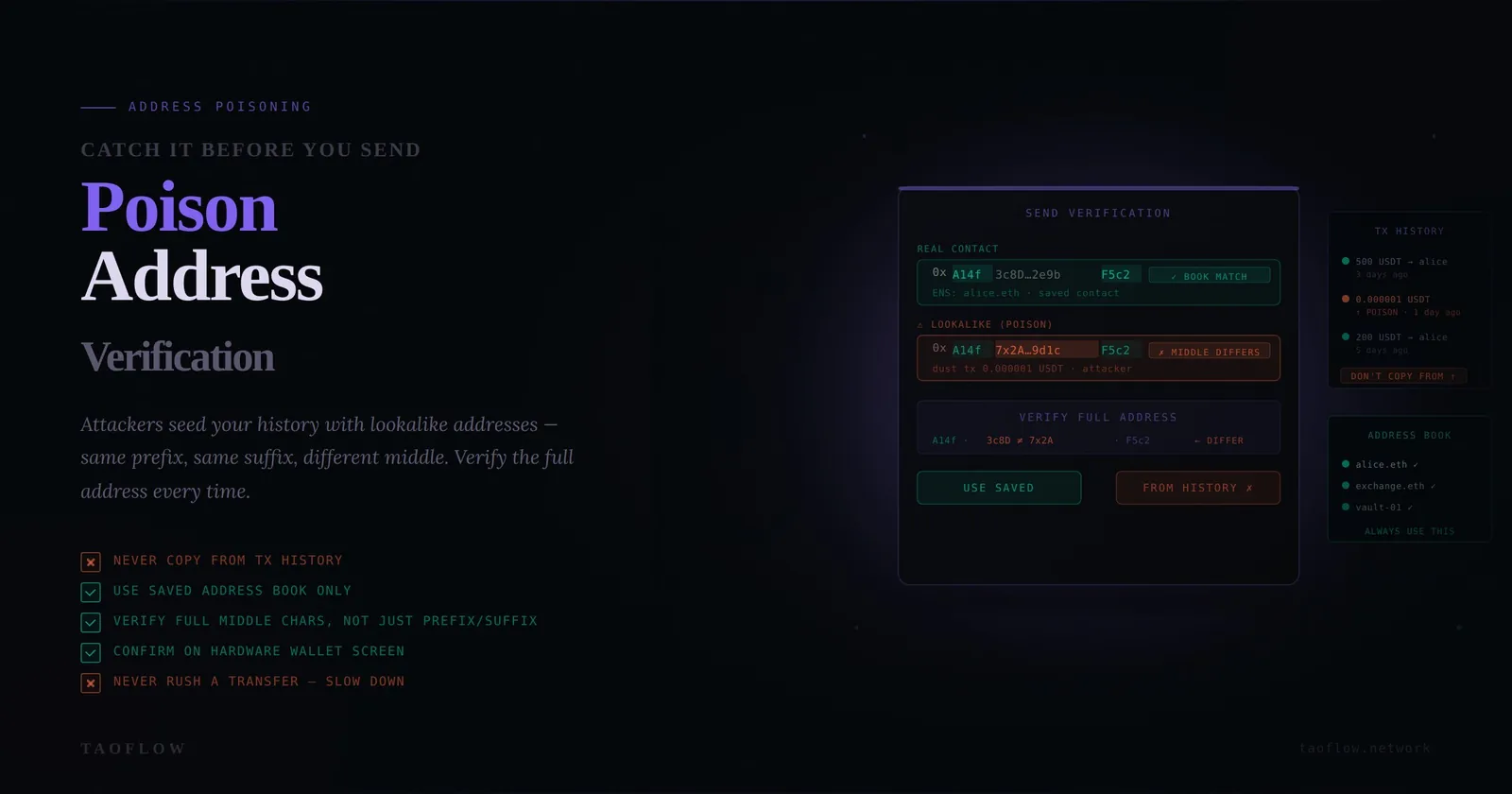
Most crypto losses are not dramatic hacks. They are small, preventable mistakes made under time pressure. One of the most common is address poisoning: attackers send tiny transactions from wallet addresses that look similar to your real contacts, hoping you copy the wrong one from transaction history.
The fix is not a new tool. It is a repeatable verification workflow. If you move funds regularly, this habit matters more than chasing every new security app.
What Address Poisoning Looks Like in Practice
A typical sequence is simple:
- You previously sent USDT to a known counterparty.
- An attacker sends a dust transaction from a lookalike address (same prefix/suffix pattern).
- Later, when you are in a rush, you open history, copy the most familiar-looking address, and send funds.
- Funds go to attacker wallet. No reversal.
No smart contract exploit required. Just interface familiarity plus human autopilot.
Threat Model: When You Are Most Vulnerable
You are at higher risk when:
- You send recurring payments to a small set of addresses.
- You rely on wallet history instead of an independent address book.
- You multitask across multiple chains and apps.
- You sign or send from mobile while distracted.
- You skip verification for “small” test transfers and later reuse the same destination.
Treat these as risk multipliers. If two or more apply, use the full checklist every time.
The 2-Minute Verification Workflow
Use this before every transfer, regardless of amount.
Step 1: Source Check (30 seconds)
- Never copy destination address from recent transaction history alone.
- Pull recipient address from a trusted source: your own saved address book, an authenticated internal system, or previously verified signed communication.
- If a person sent you a new address, confirm over a second channel (for example: chat + voice).
Step 2: Structural Check (30 seconds)
- Verify chain/network first (Ethereum, Arbitrum, Tron, etc.).
- Confirm address format matches expected chain.
- Compare more than first/last 4 characters; check at least 8–10 characters spread across beginning, middle, and end.
- For high-value sends, use wallet ENS/name resolution only as helper, not as sole trust signal.
Step 3: Context Check (30 seconds)
- Ask: “Does this transfer make sense now?”
- Validate amount, token, and purpose against your intent (invoice, rebalance, withdrawal, payroll).
- If any mismatch appears, stop and restart verification from source.
Step 4: Confirmation Check (30 seconds)
- For new or changed addresses, send a tiny test amount first.
- Confirm recipient acknowledges correct receipt before full transfer.
- Save verified destination with a clear label and date (example: “Vendor A - USDT Tron - verified 2026-04-03”).
That is it. Four short checks, done consistently.
Daily Habits That Reduce Poisoning Risk
Add these once and keep them running:
- Maintain a clean allowlist of frequent recipient addresses.
- Remove stale or unused saved addresses monthly.
- Separate “hot spending wallet” and “treasury wallet” to reduce blast radius.
- Use dedicated device/browser profile for financial actions only.
- Turn off nonessential browser extensions in your signing profile.
If you use a privacy-focused access layer such as TaoFlow for sensitive crypto operations, treat it as one layer only; verification discipline still does the heavy lifting against address poisoning.
Team Workflow (If You Operate Shared Treasury)
For teams, replace individual memory with process:
- Require dual review for new withdrawal addresses.
- Store approved addresses in a versioned internal registry.
- Log who approved, when, and via which channel.
- Enforce cooling period (for example 30 minutes) before first large transfer to a newly added address.
A lightweight process beats post-incident forensics every time.
Red Flags That Mean “Stop Immediately”
Pause transfer if you notice any of these:
- “Looks familiar” but not explicitly saved/verified destination.
- First and last characters match, middle section differs.
- New address shared with urgency (“send now, old wallet broken”).
- Unexpected chain switch request right before payment.
- Wallet UI shows recent tiny inbound/outbound dust transactions around your normal counterparties.
When in doubt, abort and re-verify. Speed is rarely worth irreversible loss.
A Printable Pre-Send Checklist
Before pressing Send, confirm:
- [ ] Destination came from trusted source (not history alone)
- [ ] Chain/network is correct
- [ ] Address spot-checked across beginning, middle, end
- [ ] Amount and token match intent
- [ ] Test transfer completed for new/changed address
- [ ] Address labeled and stored after successful verification
Use this as your default operating routine. Good security in crypto is not luck; it is boring consistency.