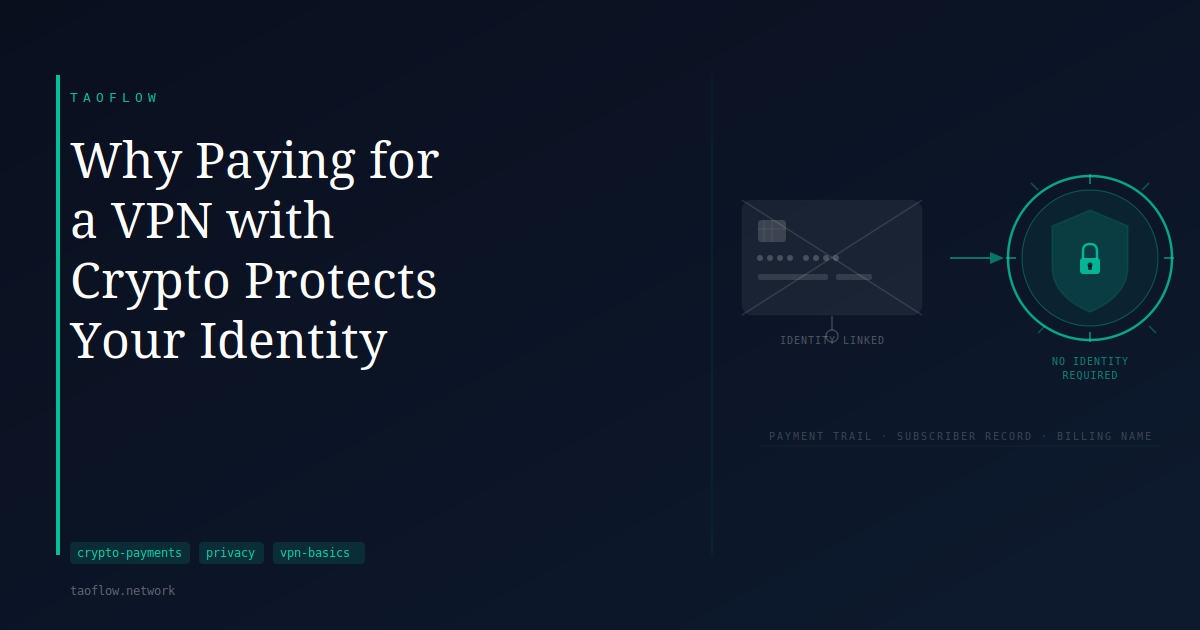
When you pay for a VPN with a credit card, you create a billing record. That record links your name, card number, and billing address to the subscription. Most VPN services also require an email address to create an account, and that email is associated with the payment. If someone with access to those records were to look, they connect your real identity to the fact that you use this VPN, and when your subscription started.
For some users, that connection is the privacy concern they were trying to avoid in the first place.
What your payment method reveals
A card payment to a VPN service creates a record in at least two places: at the card issuer and at the VPN provider. The card issuer's record includes the merchant name, date, and amount. The VPN provider's record typically includes the cardholder's name, billing address, and email.
Neither of these records is about which websites you visited or what your traffic contained. But they establish a specific fact: you are a subscriber of this VPN service, starting on this date. Combined with your account email, they anchor your VPN use to a real identity.
This matters for a particular kind of privacy concern — not traffic surveillance, but subscriber identification. A VPN that keeps no traffic logs can still identify you as a customer through payment and account records.
How cryptocurrency payments differ
Cryptocurrency transactions work differently from card payments. When you send cryptocurrency to pay for a VPN, you are sending from a wallet address. The provider receives funds; they do not receive your name, bank details, or billing address.
If you also avoid creating an account — providing no email and no login credentials — then the provider has no record that connects your identity to the subscription. They know a payment was received and a config was issued. They do not know who sent it.
This is not absolute. Cryptocurrency transactions on most public blockchains are visible to anyone who looks. If a wallet address can be connected to your identity through an exchange purchase, a know-your-customer verification, or a previous transaction to an identified address, the payment is not fully unlinkable. The privacy level depends on where the crypto came from and how it was acquired.
What crypto payment does not fix
Paying with cryptocurrency removes the payment trail. It does not remove every other way a provider can identify you.
If you sign up with an email address, that email can often be linked back to your identity. If you access the provider's website from a home IP address, that IP is logged in the web server's request records. If you use a browser with tracking cookies that have been active on other sites under your real identity, those signals carry through.
Crypto payment also does not affect what happens inside the VPN tunnel. The provider can observe connection timestamps, data volumes, and which server you connected to, regardless of how you paid. And it does nothing to protect against the sites you visit seeing the VPN server's IP and attempting to fingerprint your browser.
Cryptocurrency payment narrows one specific gap: the payment and subscriber record. The other gaps require other approaches.
Account-free access as a further step
Some VPN services issue access without requiring an account at all. When there is no account, there is no email address, no login credentials, and no username associated with the subscription. Access is delivered as a token or config file rather than being tied to an identity.
This removes the need to trust the provider's account management. There is no email database to breach, no account to subpoena, no username to correlate with other services. The connection between your identity and your VPN use is limited to whatever record the payment created — which, for a crypto payment made from an unlinkable wallet, may be minimal.
Services like TaoFlow combine this model: no account creation, no email required, payment accepted in cryptocurrency, access delivered as a WireGuard config file tied to a bearer token.
What this means for you
The right payment method depends on what you are protecting and from whom.
If your concern is your ISP watching your traffic content, payment method is largely beside the point — a VPN addresses that regardless of how you paid. If your concern is that a VPN provider could be asked to identify you as a subscriber, then payment method and account structure matter considerably more.
Paying with cryptocurrency and avoiding account creation reduces the records that could identify you as a specific customer. It does not eliminate them — a traced wallet and a well-logged provider server still leave a trail. But it removes the most direct and readable link: a billing record with your legal name on it.
Consider where your crypto comes from before assuming it offers strong privacy. Funds purchased on an exchange that required identity verification carry a paper trail back to you. Funds that have moved through several addresses without touching identified accounts are harder to link.
Cryptocurrency payment is one layer in a broader privacy setup, not a complete solution on its own. It removes a specific, concrete record — the billing paper trail. Whether that record is the one you are concerned about is worth thinking through carefully before assuming the answer either way.