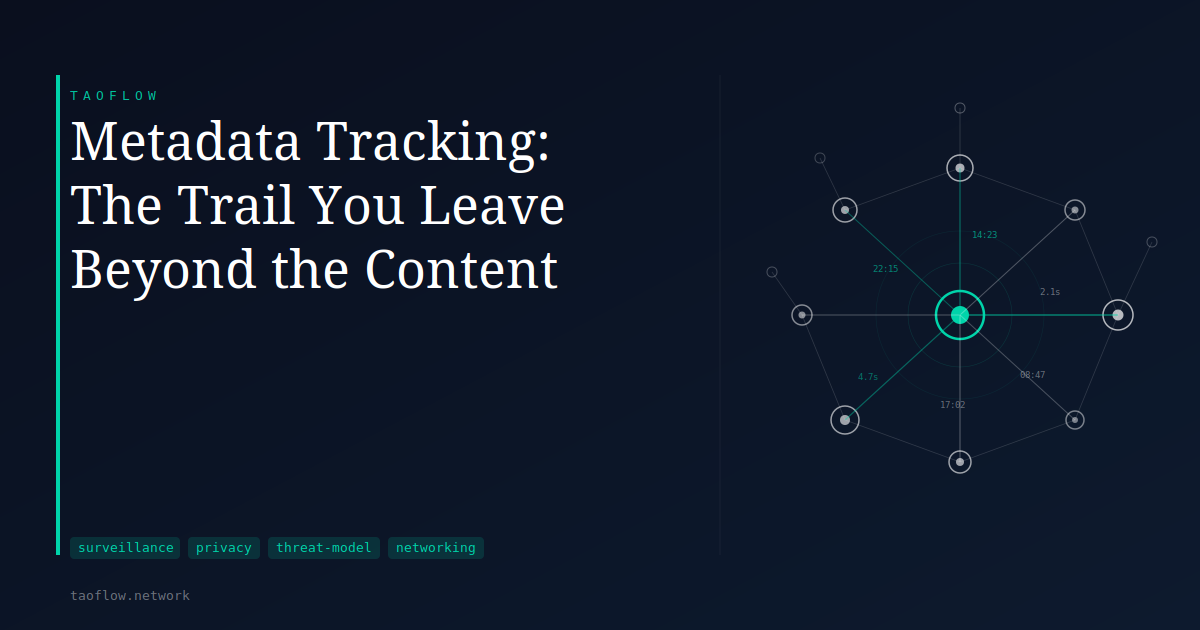
Imagine someone cannot read the letters you send, but they can see the envelope: who you wrote to, when, how often, and how many pages. Over weeks and months, that stack of envelopes reveals your social circle, your routines, and your patterns. The content stays sealed; the map of connections does not.
This is roughly how metadata works in digital communications—and why privacy conversations that stop at encryption are incomplete.
What Metadata Is
Metadata is information about communication rather than the communication itself. When you send an email, the message body might be encrypted end-to-end, but the headers still record who sent it, who received it, when, from which IP address, and through which mail servers. When you make a phone call, the carrier logs the numbers involved, call duration, and cell towers used—regardless of whether the call content was encrypted in transit.
For web browsing, metadata includes which IP addresses you connect to, when, how often, and how long each session lasts. Even with HTTPS encrypting page content, an observer watching network traffic can often identify the sites you visit by the size and timing of data packets—a technique called traffic analysis.
Why Patterns Tell a Story
A set of metadata can tell a surprisingly complete story without ever reading what was said. Knowing that someone connected repeatedly to the IP addresses of a medical clinic, a pharmacy, and a health insurance provider—without reading any of those communications—suggests a health situation. Patterns of connection timing, contact frequency, and changes in behavior are readable from metadata alone.
This is not theoretical. Bulk collection of connection metadata—who contacts whom, when, and for how long—has been a documented feature of large-scale surveillance programs in multiple countries. Content collection is harder to justify legally and technically; metadata collection typically requires a lower legal threshold. Metadata is also structured and machine-readable, which makes it easy to analyze at scale in ways that unstructured content is not.
What Encryption Protects and What It Does Not
End-to-end encryption protects content. An attacker who intercepts a message in transit cannot read what was written. This is a meaningful protection worth using.
But encryption does not hide:
- The IP addresses of the parties communicating (without additional routing)
- The timing, frequency, and duration of communications
- Packet sizes, which can hint at the nature of content even without decryption
- The infrastructure involved—email providers, messaging servers, VPN endpoints
A VPN addresses a specific slice of this problem. It hides destination IP addresses from your ISP, replacing them with the VPN server's IP in your ISP's logs. Your ISP sees traffic going to one address rather than to many individual sites. This is useful—it limits what your ISP can observe about your browsing habits. But the VPN provider becomes the entity that sees those destination patterns. Shifting who can see your metadata is different from eliminating metadata.
Practical Approaches to Reducing Metadata Exposure
Fully eliminating metadata exposure is not achievable for typical use. Some tools reduce specific parts of it:
Onion routing (as used by Tor) adds layered encryption and multi-hop routing to obscure the relationship between sender and destination, making traffic analysis substantially harder. The trade-off is latency. Messaging applications like Signal are designed to minimize metadata stored on their servers, retaining only limited technical records about accounts. These design choices reduce what any one party can observe—but they do not make metadata disappear from the network entirely.
For most practical situations, the relevant question is not "how do I eliminate all metadata?" but "who can see my metadata, and what can they do with it?"—which is a threat-model question more than a technical one.
What This Means for You
When thinking about your own digital privacy, consider which observers are present for each type of communication:
- Your ISP can see which services you connect to, when, and for how long—even when HTTPS is in use everywhere. A VPN shifts this visibility to the VPN provider.
- Websites you visit see your IP address and can build behavioral patterns from timing and frequency even without reading specific content.
- Email and messaging providers may retain metadata—headers, contact graphs, timestamps—separately from any content encryption they offer.
- Cross-site tracking allows your pattern of visits across multiple sites to be correlated, especially when you are logged into services that share advertising or analytics infrastructure.
Reducing metadata exposure typically means choosing services that collect less, understanding which entities are positioned to observe your communications, and using routing tools where the threat model calls for them. Encryption protects what you say. Metadata reduction is a separate question about who can see that you spoke at all—and to whom.
The structure of communication often reveals as much as the content. Understanding the difference between content privacy and metadata privacy is the starting point for making informed decisions about either.