When you connect through a VPN, the website you visit sees the VPN server's IP address instead of your own. But which IP address — and whether you share it with other users — shapes your privacy in ways that are not always obvious.
This distinction between shared and dedicated IP addresses is one of the more nuanced choices in VPN configuration. Understanding it helps you match a VPN to what you actually want to protect.
How VPN IP Addresses Work
Every device on the internet communicates using an IP address. When you route traffic through a VPN, your outgoing requests appear to come from the VPN server's IP address. The destination website — whether that is a news site, a forum, or a streaming service — logs that server IP, not your real one.
VPN providers own a pool of IP addresses assigned to their servers. The question is whether those IPs are shared among many users simultaneously or reserved for a single user at a time.
Shared IPs: The Privacy Advantage
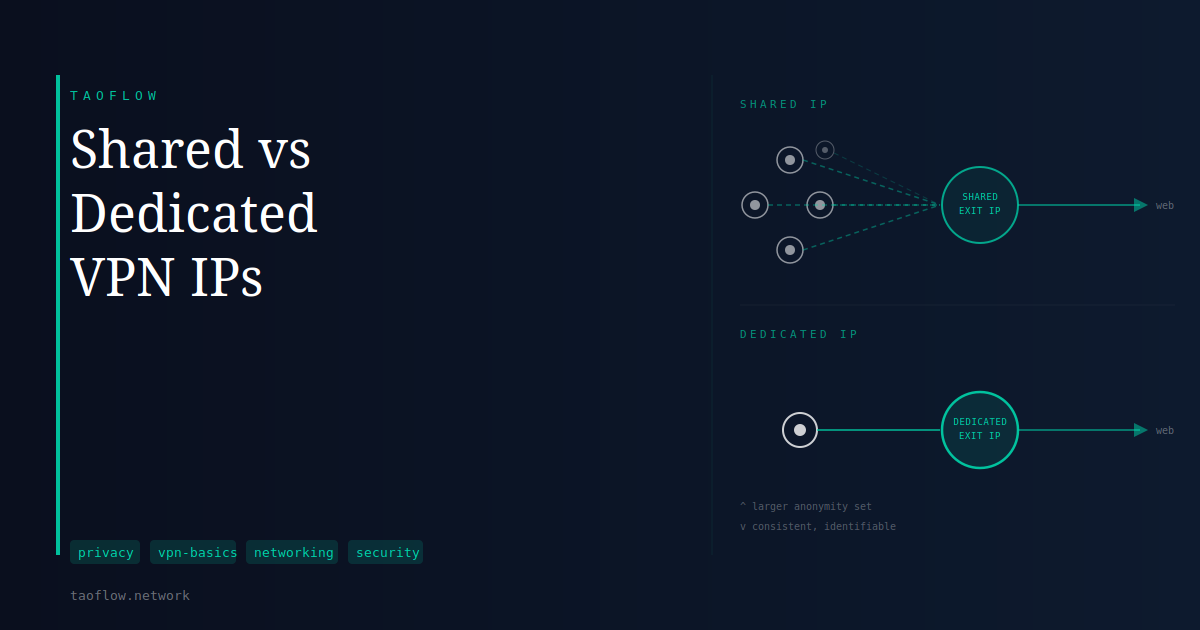
Most consumer VPN services use shared IP addresses by default. Many users exit through the same IP address at the same time.
This creates a meaningful privacy property: if thousands of connection attempts come from one IP address, it becomes genuinely difficult to link any single one back to a specific user. Your traffic blends with everyone else's. The IP address itself tells an observer very little about you individually.
Shared IPs also help with a subtler concern. If a VPN provider were compelled to produce records, shared IPs make attribution harder — the address alone cannot identify you without additional session data. That said, a shared IP is not a substitute for a verified no-logs policy. An IP shared by many users can still be traced to a specific session if connection timestamps are retained.
There is a practical downside: shared IPs develop reputations. If other users on the same IP engage in abuse — sending spam, attempting logins at scale, or scraping aggressively — IP reputation services may flag or block that address. You may find yourself solving CAPTCHAs or getting access denied at services that treat the IP as suspicious.
Dedicated IPs: The Consistency Advantage
A dedicated IP address is assigned to you alone. Every time you connect, you exit through the same address, and no one else uses it.
This eliminates the reputation contamination problem. Because the IP is yours alone, its history reflects only your own traffic patterns. Services that block shared VPN IPs are more likely to accept a dedicated one that has not been abused.
Dedicated IPs are particularly useful for accessing systems that allowlist specific addresses — a company's internal network, a server behind a firewall, or services that require IP-based authentication. If your workflow depends on being recognized by a fixed IP, a shared pool will not serve you.
The privacy trade-off is direct: a dedicated IP narrows the anonymity set to one. If someone can observe both your connection to the VPN and the traffic from the dedicated IP, they can correlate the two with confidence. The blending that makes shared IPs useful for privacy disappears entirely.
What Neither Type Protects Against
It is worth being precise about what each IP type does and does not do.
Neither a shared nor a dedicated VPN IP prevents tracking through browser fingerprinting, cookies, or logged-in accounts. If you visit a site while signed in, that site knows who you are regardless of which IP the request comes from. The IP address is one data point among many, and for most online tracking it is not the most reliable one.
A dedicated IP also does not hide the fact that you are using a VPN. Many services maintain lists of known VPN IP ranges. A dedicated IP from a VPN provider's address space may still be identified as a VPN address by detection systems, even if it has not been flagged for abuse.
The Anonymity Set
One useful way to think about this trade-off is through the concept of an anonymity set — the group of people an observer cannot distinguish among. A shared IP with many simultaneous users creates a large anonymity set. A dedicated IP creates an anonymity set of one.
This does not mean dedicated IPs are always worse for privacy. If your goal is to be recognized by specific systems, or to avoid being blocked because of others' behavior, consistency matters more than blending. The right choice depends on what you are actually trying to accomplish.
What This Means for You
If your priority is hiding your identity from the sites you visit, a shared IP offers a meaningful advantage. The more users share an IP at any given time, the harder it is for a third party to link traffic to you specifically.
If your priority is consistent, reliable access — accessing a company network by allowlisted IP, logging into services that block shared VPN addresses, or building a stable digital presence for a specific purpose — a dedicated IP is the practical choice, with the understanding that it reduces the privacy blending effect.
If you are using a VPN primarily to reduce what your ISP can observe, this distinction matters less. Either configuration hides the content of your traffic from your internet provider. The IP type primarily affects what destination services can infer about you.
For most people with general privacy goals, a shared IP is the better default. A dedicated IP is a specialized tool for specific use cases, and it comes with a specific privacy cost worth understanding before you choose it.
A shared IP makes you one person in a crowd. A dedicated IP makes you the only person at the window. Both have legitimate uses — the choice should follow from what you are actually trying to protect.