When someone wants to protect their online activity, they often find themselves comparing two tools: Tor and a VPN. Both obscure what you're doing from observers on your network. But they work in fundamentally different ways, and the threats each one addresses are not the same. Choosing between them — or deciding to use both — depends on what you're actually trying to protect against.
How Each Tool Works
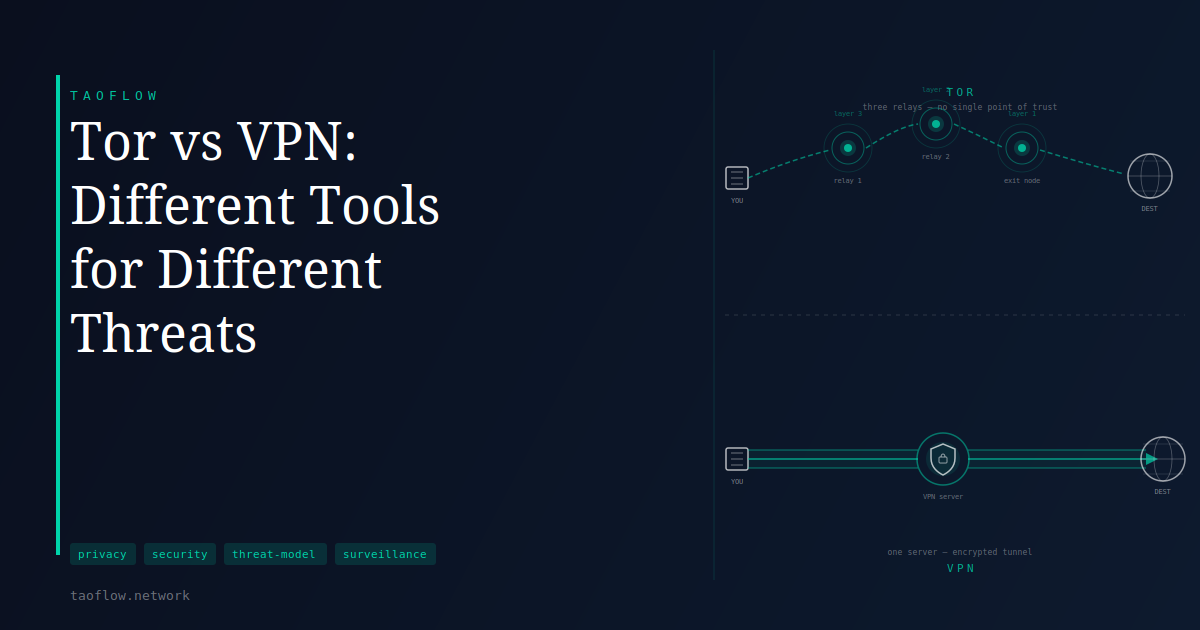
A VPN creates an encrypted tunnel between your device and a server operated by your VPN provider. Your internet traffic passes through that tunnel, so your ISP sees only that you're connected to a VPN server. Websites and services you visit see the server's IP address instead of yours. The VPN provider, however, can see your unencrypted traffic and your real IP — unless they have an audited no-logs policy and no legal obligation to collect it.
Tor — short for The Onion Router — routes your traffic through three separate volunteer-operated servers called relays. Each relay strips one layer of encryption and forwards the packet, but it knows only the previous and next hop in the chain. No single relay knows both who you are and what you're accessing. The final relay, called the exit node, sends your request to its destination, which sees the exit node's IP address rather than yours.
What a VPN Protects Against
A VPN is well-suited to two things: keeping your traffic content away from your ISP, and replacing your IP address as seen by the sites and services you visit.
If your concern is that your internet provider monitors your browsing or sells usage data to third parties, a VPN addresses that directly. Your ISP sees only an encrypted connection to a VPN server, with no visibility into what sites you're visiting or what you're doing there. If you want to prevent websites from logging your real IP address or rough geographic location, a VPN substitutes the provider's IP for your own.
VPNs are also fast enough for everyday use. The overhead of routing through one server is usually small enough that video calls, streaming, and ordinary browsing work normally.
What a VPN does not do: it does not hide your activity from the VPN provider itself. You are shifting trust from your ISP to the provider. Whether that shift is meaningful depends on the provider's logging practices, jurisdiction, and track record.
What Tor Protects Against
Tor is designed for stronger anonymity than a VPN can provide. Because traffic passes through three independent relays, no single party can see both your identity and your destination. The first relay knows your IP address but not where your traffic is going. The exit relay knows the destination but not who originated the request.
This separation matters when even your VPN provider knowing your identity is too much. A journalist communicating with a sensitive source, a researcher accessing information in a country with a monitored network, or anyone who needs to ensure that no single entity can link their identity to a specific online action — these are the situations where Tor's architecture provides a meaningful advantage over a VPN.
Tor also supports .onion addresses, which are hidden services that exist entirely within the Tor network. A .onion address does not route traffic through the public internet. Neither the visitor nor the service reveals its real IP address to the other.
Where Each One Falls Short
VPNs have a single point of trust. If your VPN provider logs activity, is legally compelled to hand records over, or is otherwise compromised, the protection collapses. A VPN is not adequate when the threat includes the provider itself or a legal authority with jurisdiction over them.
Tor has a different set of limitations. It is significantly slower than a VPN because traffic crosses three relays, often in different countries. Streaming video, large downloads, and real-time voice calls are impractical over Tor. Many websites block connections from known Tor exit nodes. And Tor protects only the traffic that routes through it — browser fingerprinting, cookies, and logged-in accounts can still identify you regardless of what path your packets take.
There is also a subtler risk: an observer with visibility across a large portion of the network could potentially correlate entry and exit traffic by timing. Tor's design makes this difficult, but it is not a theoretical impossibility for a sufficiently resourced adversary.
What This Means for You
If your main concern is ISP monitoring, your IP address being logged by services you use, or accessing content that is restricted in your country, a VPN is the more practical choice. It is faster, easier to set up, and adequate for most everyday threat models.
If you need to protect your identity from a broader range of observers — including your VPN provider — or if the connection between your identity and a specific online action must be genuinely difficult to establish, Tor is the better tool. The Tor Browser includes default settings that reduce common anonymity risks such as browser fingerprinting and JavaScript-based IP disclosure.
Some people layer the two: routing a VPN connection through Tor, or routing Tor traffic through a VPN first. Each approach trades off different properties, and neither is universally better than using either tool on its own.
Tor and VPNs are not competing products. They are complementary tools built for different threat models. Understanding what each one actually protects against — and what it leaves exposed — is the starting point for using either one effectively.