Most crypto losses do not come from complex protocol exploits. They come from ordinary people approving the wrong transaction in ordinary moments: tired, rushed, distracted, or overconfident.
A bad transaction often looks almost correct. The website feels familiar. The token symbol seems right. The amount is “small enough to test.” You click confirm and only later realize you approved an unlimited allowance, signed a malicious permit, or sent funds to a poisoned address.
The fix is not paranoia. The fix is process.
This guide gives you a verification workflow you can run before every send, swap, bridge, approval, or signature request. It is designed to be fast enough for daily use and strict enough to prevent common losses.
Why “simulation first” matters
You cannot reliably inspect raw transaction data mentally under pressure. Even experienced users miss details when interfaces are inconsistent across wallets and dApps.
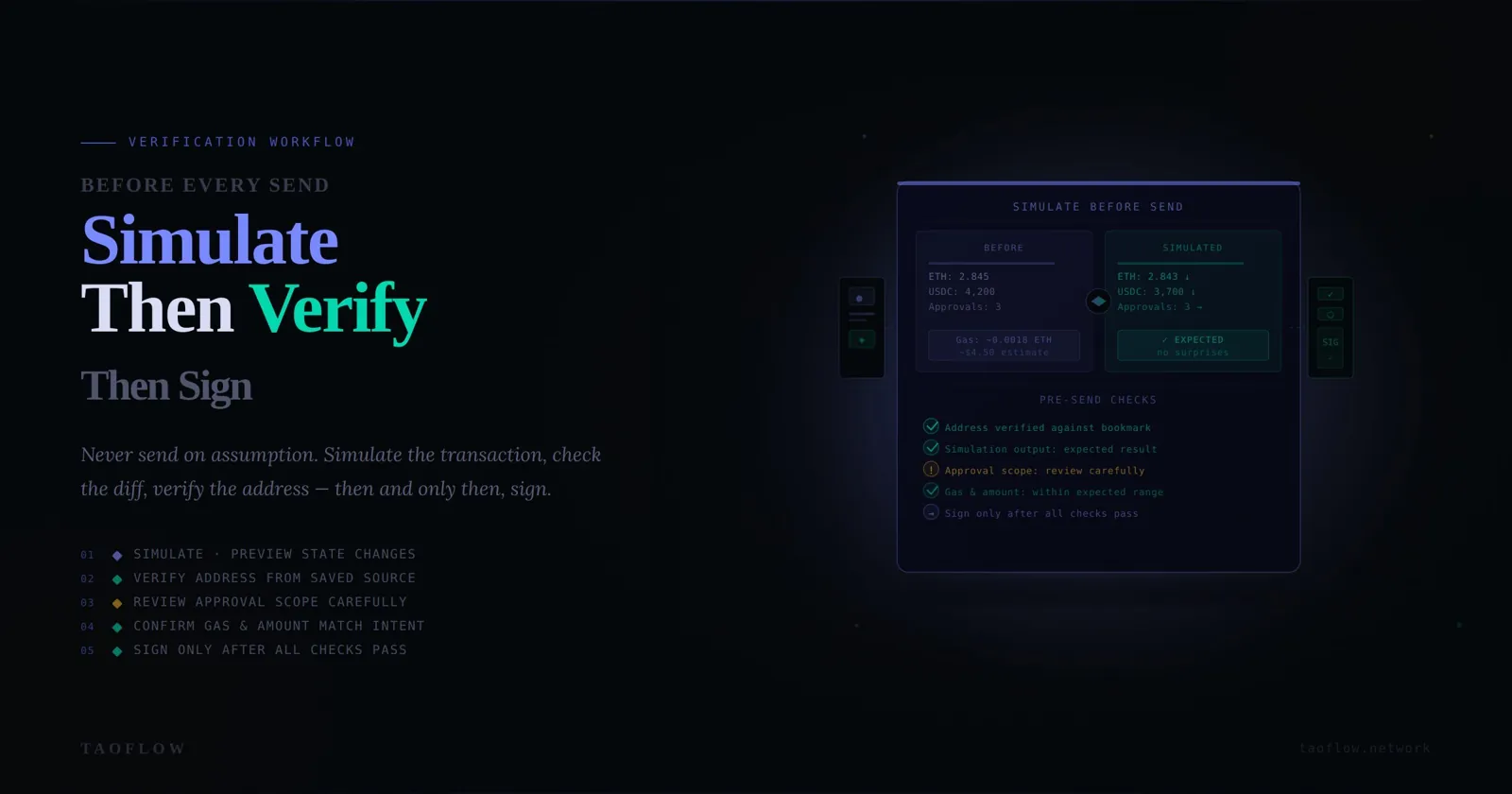
Simulation gives you a preview of expected outcomes:
- Which token balance will change
- Whether approvals are being set or modified
- Whether NFTs or other assets move unexpectedly
- Whether gas behavior is unusual for the action
Simulation is not perfect, but it catches obvious mismatches before they become irreversible.
The 7-step verification workflow
Use these steps in order. If any step fails, stop and investigate.
Step 1) Confirm intent in plain language
Before opening your wallet, write one sentence:
“I am sending 250 USDC on Arbitrum to my own cold-wallet funding address.”
That sentence is your ground truth. Every screen you see must match it.
Checklist:
- Asset name and exact amount
- Chain/network
- Destination type (exchange deposit, own wallet, vendor, friend)
- Expected side effect (send only, or send + approval, etc.)
If you cannot state intent clearly, do not transact yet.
Step 2) Verify destination through two independent sources
Never trust a single copy/paste source for addresses.
Use two-channel verification:
- Source A: original destination record (your password manager note, your signed runbook, or your known address book)
- Source B: an independent channel (hardware wallet screen, previously verified test transfer history, or a second device showing saved destination)
Compare:
- First 6 and last 6 characters
- Middle segment (at least 4 characters)
- Network compatibility (ERC-20 vs TRC-20 vs native chain)
Address poisoning often fools users who check only prefix/suffix. Add a middle check every time.
Step 3) Dry-run with a safe simulator or wallet preview
Before final approval, use simulation or wallet preview.
You want answers to:
- What leaves my wallet?
- What enters my wallet?
- Are there hidden approvals?
- Is spender address expected?
If using an approval flow, verify:
- Spender contract name/address
- Allowance amount (exact amount is safer than unlimited)
- Expiration if supported
If simulation fails or returns ambiguous output, treat it as a warning, not a harmless glitch.
Step 4) Decode signature type before signing
Not all signatures are equal.
Common categories:
- Simple transfer transaction: usually straightforward asset movement
- Approval transaction: grants contract permission to spend your token
- Permit / typed-data signature: can authorize spending or actions without an on-chain approval transaction
- Blind signature: dangerous when details are hidden
Rules:
- Avoid blind signing whenever possible
- If wallet cannot decode key fields, switch tools or stop
- Never sign “just to log in” unless you understand requested permissions
A signature is an authorization event. Treat it like granting API keys, not clicking “OK.”
Step 5) Execute micro-test when risk is non-trivial
For new destinations, new chains, or large amounts:
- Send a small test amount first
- Confirm arrival and usability
- Repeat full verification for the final amount
A micro-test is cheap insurance against:
- Wrong network
- Wrong memo/tag rules
- Unsupported token contracts
- Address clipboard malware side effects
For internal transfers between your own wallets, define a threshold (for example, above 2% of holdings) that always requires micro-testing.
Step 6) Final authorization on a trusted device state
Before clicking confirm:
- Disconnect unnecessary browser tabs/extensions
- Ensure device is on trusted network path
- Check system clock is sane (prevents some session/auth oddities)
- Re-read wallet confirmation screen aloud
Read aloud:
- “Send 250 USDC”
- “To 0xABCD...1234”
- “On Arbitrum”
- “Network fee approximately ...”
This 10-second pause catches surprising errors.
Step 7) Post-transaction validation and logging
After broadcast:
- Verify on explorer from a trusted bookmark
- Confirm status and final recipient
- Record tx hash + intent note in your log
For approvals/signatures, add:
- Spender address
- Allowance amount
- Planned revocation date
A simple transaction log becomes your incident response accelerator later.
High-risk patterns that should trigger an automatic stop
Create “stop rules” you never override when rushed:
- Wallet asks for unlimited approval when exact amount is possible.
- Spender address is new and unnamed.
- dApp URL differs from your bookmark, even slightly.
- Signature request text is unreadable or truncated.
- Transaction simulation shows extra token movement.
- Gas estimate is wildly out of family for the action.
- You are being time-pressured by chat, social posts, or support DMs.
When a stop rule fires, pause for at least 15 minutes and restart from Step 1.
Minimal tool stack for safer verification
You do not need dozens of tools. You need consistency.
Recommended baseline:
- A wallet that clearly decodes transaction/signature details
- A hardware signer for high-value wallets
- Trusted bookmark list for explorers and dApps
- Password manager secure note for verified destination addresses
- Simple transaction journal (spreadsheet or markdown file)
Optional: if you use TaoFlow for private connectivity, keep it as infrastructure rather than a decision-making tool; verification discipline still matters most.
Team workflow: dual-control for shared funds
If you manage treasury, DAO, or family funds, use dual-control:
- Preparer drafts transaction intent and destination proof
- Approver independently verifies address, network, and simulation output
- Signer executes only after both checks pass
Store the checklist outcome with tx hash. This prevents “I thought you checked it” failures.
5-minute daily drill to keep the workflow automatic
Security habits fail when they are not rehearsed. Run this drill once daily:
- Open your transaction checklist template.
- Pick one past transaction and re-verify whether your recorded intent matched actual outcome.
- Revoke one stale approval if found.
- Confirm your top 3 destination addresses still match your trusted records.
- Update one stop rule based on new scam patterns you observed.
The goal is muscle memory. Under stress, you will perform what you practiced.
Incident fallback if you suspect a bad signature
If you think you signed something malicious:
Immediate actions (first 15 minutes):
- Move remaining assets to a clean wallet if safe and possible.
- Revoke suspicious approvals from a trusted interface.
- Rotate critical credentials (email, exchange, password manager, cloud).
- Remove unknown browser extensions and isolate affected device.
First 2 hours:
- Export timeline: URLs visited, signatures, tx hashes, times
- Notify relevant counterparties (team, exchange support, multisig members)
- Flag compromised addresses in your internal records
Do not continue normal trading until containment is done.
Final checklist (copy/paste)
Use this before every meaningful transaction:
- [ ] I can state transaction intent in one sentence.
- [ ] Destination verified through two independent sources.
- [ ] Network/token format confirmed.
- [ ] Simulation or preview matches expected outcome.
- [ ] Signature type understood (not blind).
- [ ] Approval amount minimized (no unnecessary unlimited approvals).
- [ ] Micro-test completed for new/high-risk flow.
- [ ] Final wallet confirmation re-read before signing.
- [ ] Explorer confirmation completed after broadcast.
- [ ] Tx hash and details logged.
When this becomes routine, phishing and operational mistakes drop sharply. The edge is not special software. The edge is running a repeatable verification workflow every single time.