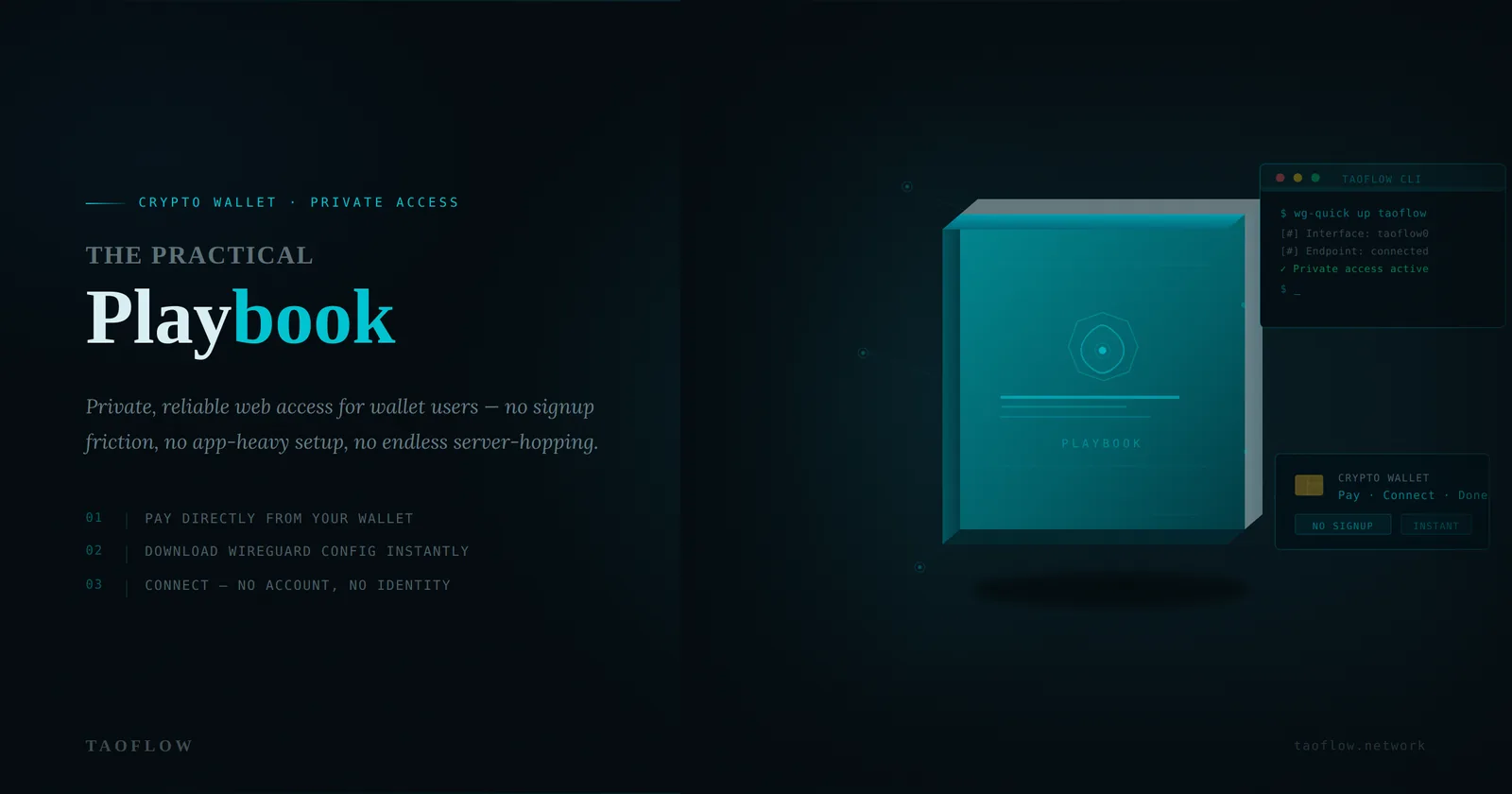
If you already use a crypto wallet daily, you likely care about two things: keeping control of your data and getting things done fast.
But private web access still often feels stuck in an older model—create an account, verify email, configure apps, test regions, fix leaks, repeat. The result is a lot of setup work for a simple goal: access the websites you need, when you need them, with less exposure.
In 2026, that gap is more obvious than ever. Wallet-native users have moved to direct, low-friction workflows. Traditional VPN onboarding has not.
This guide is a practical playbook for people who are not beginners, already hold crypto, and do not want to spend their day debugging private access tools.
The real problem is not just privacy—it is access quality
Most people describe their goal as “I need privacy.” But in day-to-day usage, the real requirement is broader:
- Access the site
- Keep the session stable
- Understand what the site is doing
- Avoid exposing more identity data than necessary
A lot of legacy flows optimize for subscription retention, not for this outcome. You are pushed through account funnels, recurring billing logic, and app ecosystems before you can even test whether access quality is acceptable for your use case.
If your baseline behavior is wallet-first, this feels backwards.
Why server-hopping became the default (and why it wastes time)
Traditional VPN users are often taught a trial-and-error pattern:
- Pick a location
- Test one site
- If broken, switch server
- Repeat until it “sort of works”
That can work for one-off sessions. It does not scale for people who need reliable browsing across research, dashboards, docs, communities, and media in one sitting.
Each switch also creates hidden costs:
- Lost session continuity
- Repeated CAPTCHAs and verification prompts
- Inconsistent page rendering
- Higher cognitive load
In short, server-hopping is not a strategy. It is a symptom of poor access workflow design.
A better model: no signup, direct purchase, direct use
A wallet-native privacy product should feel like the rest of your crypto stack:
- No signup: you should not need to create another identity relationship just to start.
- Direct purchase: pay directly with crypto from your wallet.
- Direct use: once provisioned, use immediately.
- Context-aware access: the connection should support real browsing behavior, not only synthetic speed tests.
This is the design logic behind TaoFlow: reduce identity surface area and reduce setup debt at the same time.
The 7-minute wallet-first playbook
Use this workflow when you want private access quickly without spending your time tuning infrastructure.
Minute 0–1: Define your session goal
Before connecting, decide what this session is for:
- Reading geo-sensitive news?
- Accessing a work dashboard?
- Researching across multiple domains?
Clear goals help you evaluate whether access is truly usable—not just whether a single homepage loads.
Minute 1–2: Purchase without account overhead
Use a flow that allows direct wallet payment without forced account creation.
This step matters because signup data is often where unnecessary identity trails begin. If the service does not need that data to deliver access, you should not be required to provide it.
Minute 2–4: Activate and connect
After confirmation, connect with the provided config. Keep this part simple:
- Use the default recommended settings
- Avoid premature “optimization”
- Confirm your connection is stable first
Most users lose time by over-tuning before they validate baseline usability.
Minute 4–6: Run a context test (not just a speed test)
Open 3–5 sites from your real workflow and check:
- Page load consistency
- Login/session continuity
- Media and script behavior
- Regional content correctness
A context test tells you whether the connection supports your actual tasks. A single benchmark number does not.
Minute 6–7: Lock in your minimal routine
Once it works, keep a repeatable routine:
- Reuse a known-good configuration
- Avoid unnecessary server switching
- Keep your browser hygiene clean
Good privacy operations are boring by design. Minimal, stable, repeatable.
What “context-aware access” means in practice
People often ask for “smart routing” or “better nodes,” but the practical definition is simpler: your connection should preserve the context of how modern websites behave.
That includes:
- Multi-domain dependencies
- Dynamic scripts
- Regional content gating logic
- Session persistence signals
When context breaks, users compensate manually—refreshing, reconnecting, switching locations, or abandoning the task. A context-aware model aims to minimize that manual overhead.
Privacy boundaries: what this solves and what it does not
A no-signup, wallet-first model can meaningfully improve:
- Onboarding friction
- Identity minimization during purchase/access
- Time-to-usable private connection
But no tool should promise “perfect anonymity.” You still need sane operational habits:
- Keep browser and extensions clean
- Avoid logging into unrelated personal accounts in the same session
- Watch for phishing and cloned domains
- Keep device security up to date
Privacy is a system, not a switch.
Who this workflow is best for
This approach is a strong fit if you:
- Already hold and use crypto in a wallet
- Want fewer identity touchpoints
- Need practical website access more than feature-heavy dashboards
- Prefer direct utility over account ecosystems
It is less about being “advanced” and more about valuing clean execution.
Final takeaway
If your private access workflow still depends on account creation, billing complexity, and endless server-hopping, you are paying a time tax every session.
In 2026, crypto-native users have a better option: no signup, direct purchase, direct use, and connection quality measured by real browsing context—not by setup complexity.
TaoFlow is built for that exact outcome: private access that starts fast, stays usable, and respects the way wallet-first users already operate online.