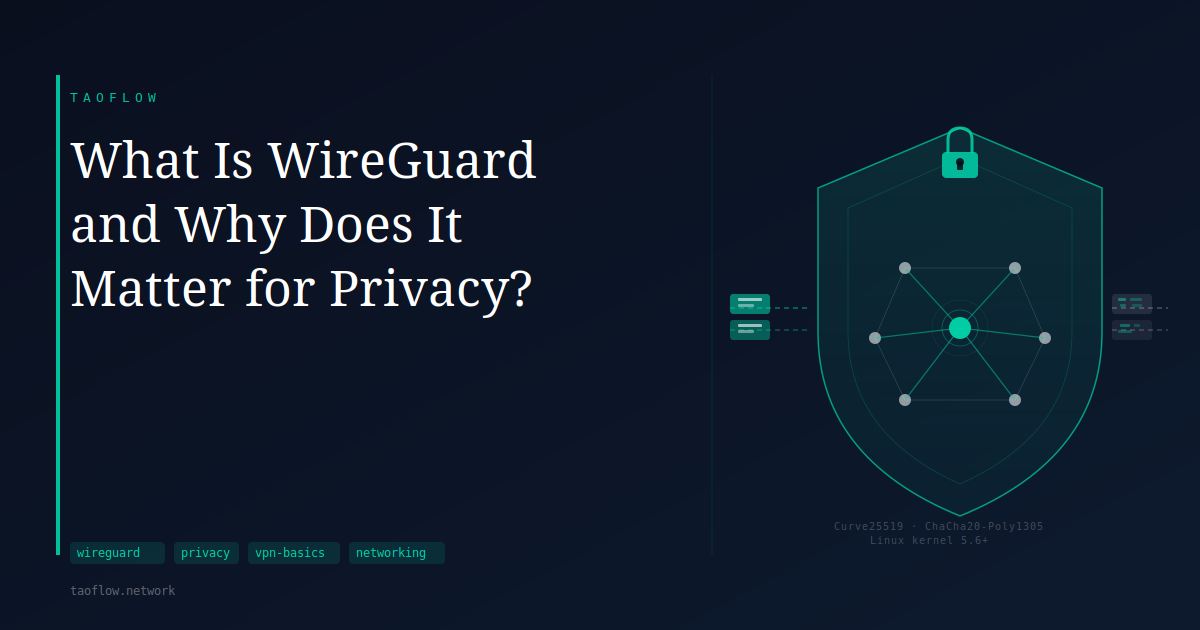
If you have looked at VPN options recently, you have probably seen WireGuard mentioned as a modern alternative to older protocols. The name appears on VPN service pages, in Linux changelogs, and in documentation for home network projects. But what WireGuard actually is — and what it does differently — is often left unexplained.
This article walks through the basics: what WireGuard is, how its design differs from older approaches, and what that means for anyone who cares about privacy.
WireGuard is a protocol, not a service
The first thing to understand is that WireGuard is a VPN protocol, not a company or a product. It is a specification for how two devices should create an encrypted tunnel and route traffic through it. Any software or service can implement that specification.
WireGuard was created by Jason Donenfeld and released publicly in 2015. In 2020, it was merged into the Linux kernel — version 5.6 — which means it now ships by default on most modern Linux systems without any additional software installation. It is also available on Windows, macOS, iOS, and Android through official client applications.
What WireGuard actually does
When you connect through a WireGuard-based VPN, your device creates an encrypted tunnel to a VPN server. All traffic you send goes through that tunnel: the server receives it, forwards it to its destination, and returns the response back through the tunnel to you.
From the perspective of your internet service provider, all they can see is that you are sending encrypted data to a specific server. They cannot read the content, and they cannot see which websites or services you are connecting to. From the perspective of the site you are visiting, the request appears to come from the VPN server's IP address, not yours.
This is the core function of any VPN. WireGuard's contribution is in how it does this.
The design choices that set WireGuard apart
Older VPN protocols like OpenVPN and IPSec were designed in an era when the primary concern was compatibility across diverse systems. They are flexible and well-tested, but they carry significant complexity. OpenVPN's codebase runs to hundreds of thousands of lines. That complexity makes audits harder and leaves more surface area for vulnerabilities.
WireGuard took a different approach. Its codebase is intentionally small — around 4,000 lines — and it uses a fixed, modern set of cryptographic primitives:
- Curve25519 for key exchange
- ChaCha20-Poly1305 for encrypting and authenticating data
- BLAKE2s for hashing
These are not configurable. There is no negotiation phase where client and server agree on which algorithm to use. The simplicity means there are fewer decisions that can go wrong and fewer options for a poorly configured setup to fall back to weaker encryption.
The protocol is also stateless in a useful way: a WireGuard interface responds only to packets containing a valid cryptographic identity. If a port scanner hits a WireGuard endpoint, the endpoint does not respond at all. This is sometimes described as "stealth" behavior, though it is better understood as silence in the absence of a valid key — the server simply ignores traffic that does not prove correct identity.
What WireGuard does not do
WireGuard handles the tunnel. It does not handle everything else.
A WireGuard connection does not automatically prevent DNS leaks, where DNS queries bypass the tunnel and reach your ISP's resolver instead of a private one. It does not prevent browser fingerprinting, tracking via cookies, or correlation through logged-in accounts. It hides your IP from destination servers and hides your traffic from your ISP — those are real and meaningful protections, but they have clear limits.
Performance is genuinely good. The kernel-level implementation and the streamlined protocol mean lower latency compared to some software-only VPN implementations. But the physical distance to the server, network conditions, and server load matter more in practice than the protocol choice.
What this means for you
If you are evaluating a VPN service or setting up your own, WireGuard is a reasonable default choice for the tunnel layer. Its small codebase and fixed cryptography make it easier to reason about than older protocols. The fact that it ships in the Linux kernel means it is reviewed by a large community and updated as part of normal OS maintenance.
Services that provision WireGuard configs — such as TaoFlow, which delivers a .conf file you connect with directly — give you the full WireGuard client experience without managing a server yourself. You can verify what the config contains before loading it, which is straightforward: a WireGuard config is a short, human-readable text file with your keys and the server endpoint.
The protocol is not a privacy guarantee on its own. It is one layer in a set of practices — alongside a trustworthy DNS resolver, browser hygiene, and a clear sense of your own threat model. Understanding what WireGuard does, and what sits outside its scope, helps you use it accurately.
WireGuard is well-suited to what it does: establishing a fast, simple, cryptographically sound tunnel between two endpoints. Its design choices favor clarity over compatibility, which is a reasonable trade for most people choosing a VPN today. What you do with that tunnel — and how you evaluate the service or setup around it — is a separate question worth spending time on.