WireGuard and OpenVPN are both VPN protocols, and both are widely used. If you have looked at VPN configuration options or evaluated a VPN service recently, you have probably seen both names. The question of which to use depends on what you are optimizing for, and the answer is not the same for every situation.
The core difference: scope and complexity
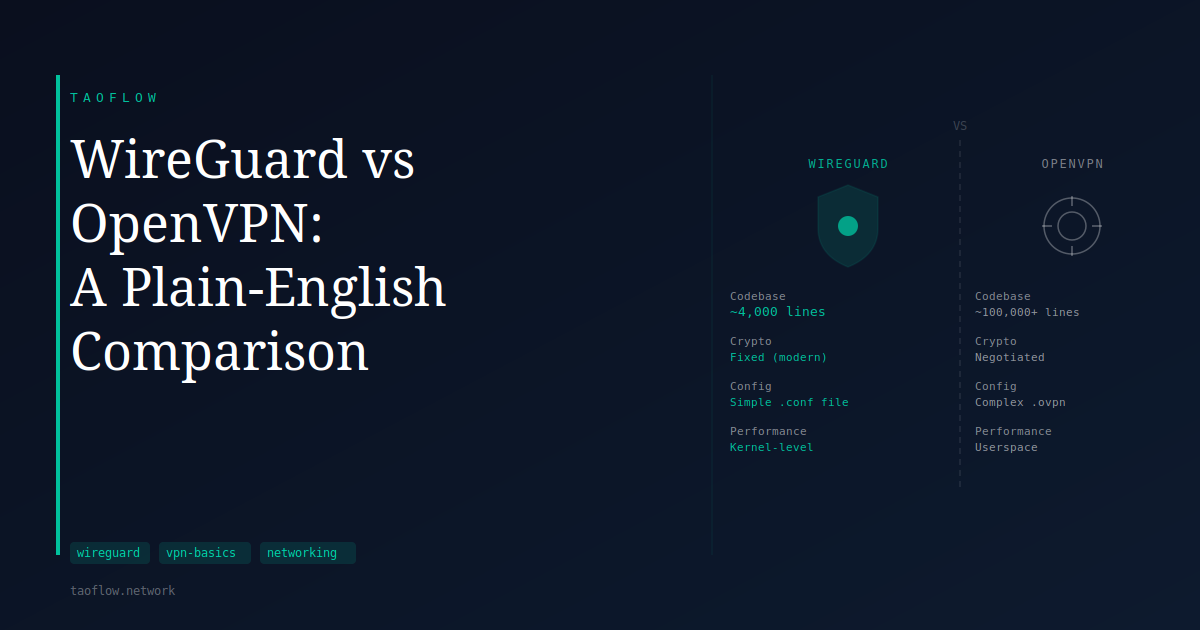
OpenVPN is a mature protocol that has been in widespread use since the early 2000s. Its design prioritizes flexibility and compatibility. It supports a wide range of cryptographic options, can run over TCP or UDP, and is capable of traversing firewalls and NAT configurations that simpler protocols cannot handle. Its codebase runs to well over a hundred thousand lines.
WireGuard is significantly newer, designed around a different philosophy: a small, auditable codebase with a fixed set of modern cryptographic primitives. The implementation is around 4,000 lines. It lives in the Linux kernel since version 5.6, meaning it is maintained as part of the kernel rather than as a separate piece of software.
The tradeoff this represents is real. OpenVPN's complexity gives it flexibility. WireGuard's simplicity makes it easier to review and harder to misconfigure.
Cryptography: fixed vs negotiated
One of the more meaningful differences for privacy-conscious users is how each protocol handles cryptography.
OpenVPN supports a large number of cipher suites and can be configured to use many combinations of encryption and authentication algorithms. This flexibility is useful in environments with specific compliance requirements, but it also means a misconfigured server might negotiate a weaker cipher than intended. The negotiation process itself adds attack surface.
WireGuard uses a fixed set of algorithms: Curve25519 for key exchange, ChaCha20-Poly1305 for authenticated encryption, and BLAKE2s for hashing. These are not configurable. There is no negotiation phase. If a future vulnerability were discovered in one of these primitives, WireGuard would require a protocol-level update — but the lack of negotiation also means there is no downgrade attack surface.
For most users, neither approach creates a practical vulnerability. Both protocols, when correctly configured, use cryptography that is considered strong. The difference matters more at the margins — in environments where configuration mistakes are likely or where the threat model includes active downgrade attacks.
Performance
WireGuard is generally faster than OpenVPN, particularly in terms of latency and connection setup time. The kernel-level implementation means less data copying between kernel and userspace compared to OpenVPN's default userspace implementation. On fast connections, the difference in throughput is measurable. On slow or mobile connections, it is often less significant in practice.
Connection handshake time — how quickly the tunnel establishes — is notably faster with WireGuard. This matters on mobile devices that move between networks frequently, since each network change requires a new handshake.
Configuration and setup
OpenVPN configuration files (.ovpn) can be complex, with many options for certificates, keys, cipher settings, and connection parameters. This is partly what enables its flexibility, but it also means there is more that can be wrong in a configuration.
WireGuard configuration files are short and readable. A typical client config is under twenty lines, covering the interface address, private key, DNS setting, and the server's public key and endpoint. The simplicity means less to troubleshoot and fewer points of misconfiguration.
Compatibility and firewall traversal
OpenVPN running on TCP port 443 — the same port used for HTTPS — is difficult to block without also blocking web traffic. This makes it effective in environments that attempt to restrict VPN use, such as corporate networks, some hotel Wi-Fi systems, and countries with network restrictions.
WireGuard runs over UDP, and its traffic has a distinctive pattern that is easier to identify and block with deep packet inspection. In environments where VPN traffic is actively filtered, OpenVPN on TCP 443 may work when WireGuard does not.
What this means for you
For general use — connecting to a VPN to encrypt your traffic on untrusted networks, to change your apparent location, or to keep your browsing private from your ISP — WireGuard is a reasonable default. It is fast, simple to configure, and well-maintained through the Linux kernel update cycle.
For environments where VPN traffic is filtered or blocked, OpenVPN on TCP 443 may be more reliable. If you are connecting to a VPN in a country or network that actively restricts VPN use, OpenVPN may be the more practical choice.
For users who receive a WireGuard config file from a VPN service, the choice has already been made. The config works with the official WireGuard client on any platform, and the setup is straightforward.
Both protocols are well-established and suitable for serious use. WireGuard's simplicity and performance make it the better starting point for most people. OpenVPN's flexibility and firewall traversal capabilities make it worth knowing about if WireGuard proves insufficient for your specific situation.